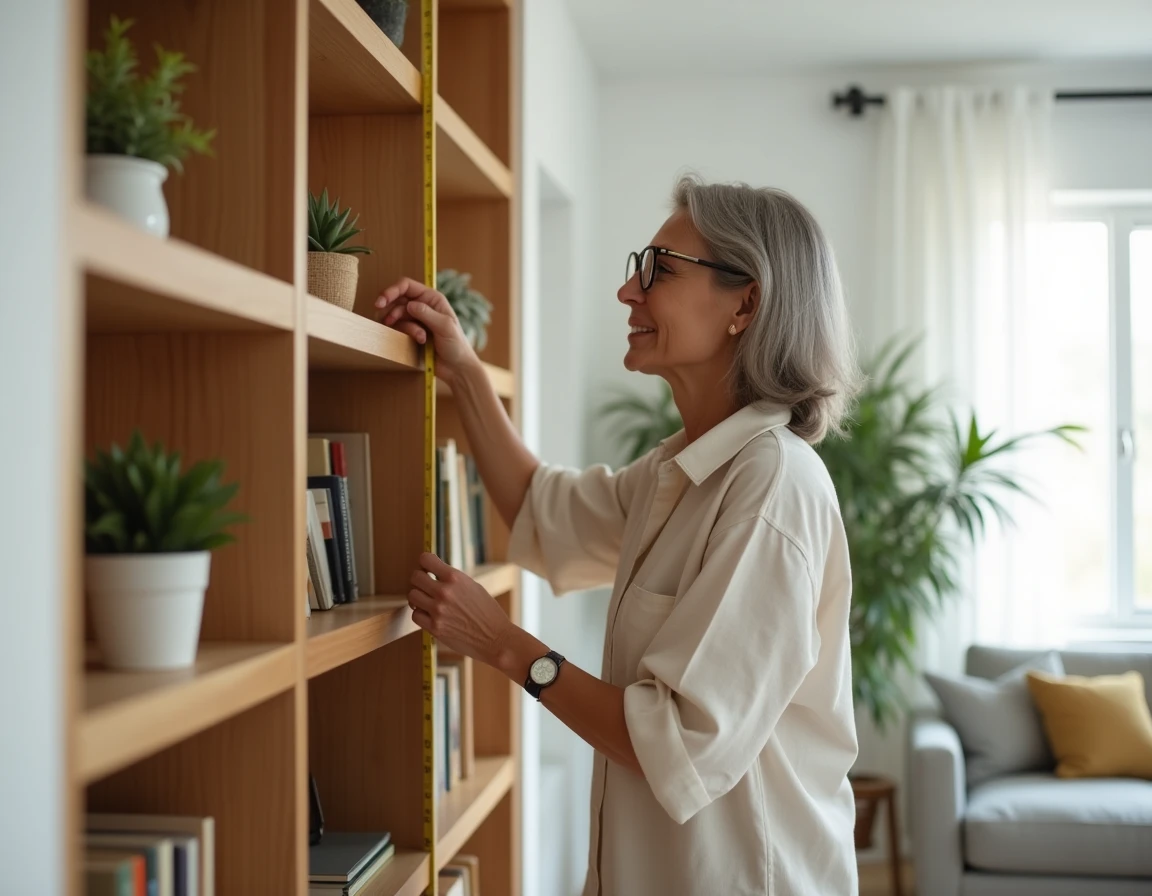
The dimensions of a bookshelf are not chosen at random. Shelf height, shelf depth, total width of the unit: each measurement directly depends on what you plan to store and the layout of your room. Comparing standard dimensions for each type of object allows you to size a piece of furniture appropriately, without wasting space or sacrificing accessibility.
Shelf Dimensions by Object Type: Comparison Table
The first instinct before setting the dimensions of a bookshelf is to inventory the items it will hold. A paperback book and a photo album do not require the same free height between shelves, nor the same depth.
| Object Type | Free Height Between Shelves | Recommended Shelf Depth |
|---|---|---|
| Paperback | 20 to 22 cm | 20 to 22 cm |
| Large Format Novel | 25 to 28 cm | 22 to 25 cm |
| Beautiful Book / Art Book | 35 to 40 cm | 30 to 35 cm |
| 33 RPM Vinyl | 33 to 35 cm | 35 cm |
| Decorative Object / Picture Frame | variable | 25 to 30 cm |
This table shows a significant difference between shelving designed for paperbacks and that intended for art books. The depth varies almost from single to double depending on the intended content. Starting from a single format often results in wasted depth space on shelves dedicated to smaller formats or cramming large volumes onto shelves that are too narrow.
To delve deeper into these guidelines, a detailed guide offers advice on bookshelf dimensions incorporating current design standards.

Usable Height and Accessibility: Dimensions Often Overlooked by Catalogs
Most standard bookshelves reach heights between 180 and 220 cm. On paper, a 220 cm unit offers more storage. In practice, shelves above 140 cm become less accessible without a step ladder.
The European standard EN 17210, published in 2021 and disseminated by Cerema in 2022, specifies the reachable heights according to the user’s profile:
- For a standing person, the comfort zone is between 90 and 140 cm in height. This is the range where frequently consulted books should be stored.
- For a person in a wheelchair, the usable range drops to between 40 and 120 cm, significantly reducing the number of truly useful shelves.
- Low shelves (under 40 cm) and high shelves (above 180 cm) are used for storing items that are rarely handled: archives, decorative boxes, closed collections.
In other words, the total height of the unit matters less than the distribution of storage zones. A well-zoned 180 cm unit will be more functional than a 220 cm unit where the upper third remains inaccessible on a daily basis.
Adapting Height to the Room
In a living room with a standard ceiling height (about 250 cm), a 200 cm bookshelf leaves enough free space at the top to avoid a feeling of oppression. Under eaves or sloped ceilings, the height should be set at the lowest point of the ceiling minus about ten centimeters for ventilation of the unit.
In a hallway or a passageway, depth becomes the critical parameter. A unit deeper than 30 cm encroaches on circulation space. It is better to opt for shelves of 20 to 22 cm, sufficient for paperbacks and small decorative items.
Bookshelf and Remote Work Space: A Recent Framing Constraint
Since the rise of hybrid work, the bookshelf has taken on a role that no one anticipated: serving as a backdrop for video conferencing. The Habitat and Remote Work Observatory (2023 report) and the French Institute of Design note a growing demand for furniture designed to frame behind a desk.
This need modifies three dimensional parameters:
The visible usable height by the camera is between 120 and 180 cm from the floor. Shelves in this zone should be the most visually appealing, as they appear on screen. The depth must accommodate a cable passage for discreet LED lighting (allow for an additional 3 to 5 cm behind the shelves).
The width of the module aligns with that of the desk, generally between 120 and 140 cm, so that the bookshelf fills the camera’s field without overflowing the frame. A wider unit creates an off-center background.
Reduced Depth: A Confirmed Trend
Several manufacturers now offer bookshelves with depths not exceeding 25 cm. This measurement is sufficient for most common books and frees up floor space in dual-use rooms (office-living room, bedroom-office). However, it excludes large formats and vinyl records, which require a minimum of 32 to 35 cm.
Shelf Span and Risk of Bending: The Overlooked Technical Parameter
A shelf that is too long without a central support will eventually sag under the weight of books. Solid wood and MDF do not react the same way.
For an 18 mm thick MDF shelf, the maximum span without intermediate support is around 60 to 80 cm depending on the load. Beyond that, bending becomes visible within a few months. In solid wood (oak, beech), the span can reach 90 to 100 cm for a comparable thickness.
If the unit exceeds 120 cm in total width, a central post or a rigid back fixed to the wall is necessary. This reinforcement divides the span in half and eliminates the risk of deformation. This is a point to check systematically on flat-pack bookshelves, whose shelves are often made of melamine particle board, which is less durable than MDF.
Wall Fixation and Safety
Any unit exceeding 150 cm in height should be secured to the wall, especially in a home with children. The anti-tip kits provided with standard furniture are sufficient in most cases, provided the wall is load-bearing or suitable anchors are used on hollow partitions.
Ultimately, the question of bookshelf dimensions boils down to three concrete trade-offs: depth (dictated by the largest object to be stored), usable height (determined by actual accessibility, not ceiling height), and shelf span (conditioned by the material and expected load). Establishing these three parameters before choosing a model avoids most sizing errors.